Chinasage : All about China
China sage's information will be of use to anyone keen to learn more about the world's upcoming nation. We cover all aspects of China in hundreds of detailed pages which include all sorts of cultural traditions , descriptions of every Chinese province and history , including all the dynasties. We hope you make ChinaSage the home for your study of China.
You can also check out your knowledge of China with our Quiz section .
Traditions
About Chinasage
We’re building an extensive set of information all about China. We found other sites too detailed (such as Wikipedia) or just too old-fashioned. What we thought was needed was a carefully constructed site with strict editorial control so that everything is consistent and easy to navigate without clutter.
The name “Chinasage” came about because it can be read as either “China sage” (中 国 英 明 zhōng guó yīng míng ) or “China’s age” (中 国 时 代 zhōng guó shí dài ) , which promotes our new knowledge resource at a time when China has come of age in the world.
Southern refuge
When northern China was overrun by Khitans and then Mongols 800 years ago the Imperial Song family moved to Hangzhou . It proved to be a peaceful and prosperous time for 150 years. In memory of this period some scenes of Hangzhou are still to be found in the long corridors of the Summer Palace , Beijing.
Getting by in China There are many customs and traditions that you should know before traveling to China. Our customs page covers such things as giving gifts, banquets, sealing business deals and how to behave in public. A respect for age old traditions will impress your hosts who will appreciate your efforts to embrace the culture. Read more…
Ancient Chinese numerology The Chinese have studied the properties of numbers from ancient times. Many interesting beliefs came from the magic square that unified other traditions such as yin-yang, five elements, compass directions and the taiju figure. Read more…
Convert measurements Our handy measurement convertor will not only do Chinese units to/from Metric/Imperial/U.S. measures but also between meters and feet; liters and pints. Just type in the measurement in length, volume, weight, area and let China sage calculate the accurate answer. Read more…
Panthay rebellion
One of the bloodiest rebellions in Chinese history took place 1853-73. The Muslims of north-western China rose up in revolt and it was brutally suppressed by the Qing government. About 2 million people (Chinese and Muslims) met their death. It would be better known if the Taiping Rebellion (1850-64) had not taken place with its about 40 million deaths. The rebellion is one reason why the current Chinese government is ruling the Muslim dominated Xinjiang province with such firmness. Read more…
Toad Frogs and toads are valued in China because they keep down insect pests on crops. In some regions their name is similar to qián 'money, coin' and this has given them an association with good fortune and luck. Read more…
China's only female ruler Empress Wu Zetian of the early Tang The shrewd and ambitious Empress Wu Zetian [624-705] came to rule China soon after the Tang dynasty had begun. Her legacy is still debated by some historians but it seems the brutality with which she is admonished was quite normal for the time period. For over 40 years she directed China's policies firstly as the Emperor Gaozong's wife and then in her own right. She championed the adoption of Buddhism in China and equal rights for women. Read more…
A history of Chinese Painting China has a very long tradition of painting. Most painting is done with the same style of brush and ink as calligraphy. Landscapes are the most cherished but exquisite paintings of nature subjects and portraits are also well represented. Read more…
Spirit Ways to Imperial Tombs For 2,000 years illustrious people had an elaborate underground burial tomb. Although many tombs have been looted over the ages, the spirit ways or sacred ways with rows of stone sculptures have often survived. Read more…
Cracking China book
Your A-Z key to understanding China
We are proud to announce a printed book all about China based loosely on this web site. It is a set of sixty topics in A-Z order covering everything from hair to kiwifruit, clapping to rhubarb, eunuchs to dragons. Buying a copy will help support Chinasage . Now available as a Kindle eBook for just $3.90.
Details... ➚
Southern refuge
When northern China was overrun by Khitans and then Mongols 800 years ago the Imperial Song family moved to Hangzhou . It proved to be a peaceful and prosperous time for 150 years. In memory of this period some scenes of Hangzhou are still to be found in the long corridors of the Summer Palace , Beijing.
History
Dip into history Our history section has a page for each major dynasty, for the whole period from the time of myths and legends 5,000 years ago all the way through the Han, Tang, Song, Ming dynasties to the last great dynasty the Qing. Read more…
Qing dynasty The end of the dynastic system in China came after a very promising and prosperous start under the wise rule of the first four Manchu Emperors. Years of decline followed with the Opium Wars and Taiping Rebellion ending in the sad tale of the Emperor Puyi Read more…
The Great Wall of China The iconic vision of the Great Wall snaking its way up mountainsides is known the world over. It stands as one of China's great accomplishments - the awe-inspiring Great Wall. Although it stands for China's enterprise and indomitable spirit, it in the end proved an expensive waste of effort. Read more…
Year of the ... Most people are familiar with the twelve years and their animals. Chinese astrology is about the year of birth rather than the month of birth and so all people born in a particular year share some characteristics. Even to this day couples arrange birth of children to fall in 'lucky' years. Read more…
Modern Leaders The leadership of the People's Republic since 1949 has been one of stability with an emphasis on steady progress. With China such a major power it is important to understand the background to the handful of people who have led China in a new direction. Read more…
4th May 1919 The Chinese reaction to the Versailles Treaty was the major turning point in modern Chinese history. Widespread student protests throughout the country led to a change in government policy and a refusal to sign the treaty. It was a nationalist movement calling for solidarity against foreign exploitation that was eventually to lead to a militarized Guomindang as well as the foundation of the Chinese Communist Party. Read more…
The Chinese Emperor The institution of Emperor , as head of the Chinese family of people, lasted for thousands of years and to some extent lives on with the Presidency. In China there has been great respect for the Emperor/President who in turn is expected to rule wisely with the best interests of his subjects in mind. To early European visitors to China the structure was considered close to the ideal form of society. Read more…
Geography
China's diverse geography China has deserts, mountains, lakes, rain forests and almost every other type of geographical feature you can think of. Our geography section has pages for each individual province as well as the great Yangzi and Yellow rivers. There are also pages on climate, cities, population, ethnic people, airports and universities. Read more…
Great City of Shanghai The huge city of Shanghai has become the leading city in Eastern Asia once again - just as it was in the 1920s. Known for its dynamism and cosmopolitanism, Shanghai rivals Beijing as the nation's most important metropolis. It is ideally placed near the mouth of the Yangzi river to act as a gateway into China. Read more…
China's Silk Road The silk road from China leading to India and also through Central Asia to the Middle East was the longest trade route by land. It allowed early contact between the Roman Empire and China when silk was in great demand in Rome. The trade brought great prosperity to the cities of Central Asia such as Samarkand and Bactra. Read more…
Understanding the Date and Time in Chinese Telling the date and time is essential for travelers. In China the Arabic numbers are used for writing but the Chinese characters are used for reading. Read more…
Chinese Cities We have all the important statistics on all the major cities in China. Gives Population, Chinese name and shows map of location within China as well as calculating distances to any other Chinese city. Read more…
Cracking China book
Your A-Z key to understanding China
We are proud to announce a printed book all about China based loosely on this web site. It is a set of sixty topics in A-Z order covering everything from hair to kiwifruit, clapping to rhubarb, eunuchs to dragons. Buying a copy will help support Chinasage . Now available as a Kindle eBook for just $3.90.
Details... ➚
Book of Changes - Deciphered
The Yi Jing is the premier ancient classic in China, and yet at the heart of this very strange but important book is a mystery that has remained unsolved for 3,000 years. The ‘Book of Changes - Deciphered’ describes the history and importance of the Yi Jing (I Ching) and proposes a new solution to the ancient mystery. Buying a copy will help support Chinasage . Now also available in Kindle eBook format for just $5.99.
Details... ➚
Language
The Chinese Language The Chinese language is rightly treasured as the country's greatest accomplishment. Our language section describes the language and its history. The section includes some introductory lessons and a guide to writing the characters. Read more…
A survey of Chinese literature As both the book and printing were invented in China it is not surprising that Chinese literature has a long and distinguished history. There are a number of very famous novels from before the time of Shakespeare including The Romance of the Three Kingdoms and The Water Margin. Read more…
Chinese characters Some Chinese characters have their origin 10,000 years ago. The very old forms are simplified pictures of objects and animals. Later more abstract notions were represented in a simple way. Now there are a total of 200,000 distinct characters but fortunately only 2,000 are needed for everyday life. Read more…
China's Ancient Script The discovery of a huge number of 'oracle bones' has greatly added to the knowledge of the origins of China's written script. It pushes back the written language to at least 3,500 years ago. Careful study of the inscriptions is still revealing information about life in Shang dynasty times. Read more…
How to write Chinese characters Many Chinese spend a great deal of time studying calligraphy. To be able to write (or more accurately paint) Chinese characters requires lots of practice as well as knowing both the brush strokes and the order in which to make them. Read more…
Overseas Aid
The Chinese diaspora have made an important cultural and financial contribution to the building of modern China. Overseas communities in Singapore, Taiwan, Thailand and Indonesia have often become rich and send back money to their families or invest in new enterprises within China. Read more…
Bits and Pieces
We need your help to keep the Chinasage web site growing. We'd love to keep this web site completely free of advertisements like Wikipedia. Please consider becoming a Patreon subscriber for however little or much you can afford. We have been running this campaign for two months and have so far raised only 10% of our target. So please help… or else advertisements will make a comeback!
To read more and take out a subscription simply click on the Patreon Patreon
Many thanks, much appreciated.
Tue 20th Sep 2022Patreon pictures Thanks to the generous donations from Chinasage's Patreon ➚ sponsors we've just added quality photographs to many of our pages.
Although you can get images of all sorts of thing for free you do still have to pay for quality, particularly for specialist subjects. This time we have used 123rf for the new images who claim to have 200 million images to choose from. It takes a long time to make a choice and then they all need editing for usage, tagging and finally putting on the appropriate place on our hundreds of pages. We hope you will agree that they make a significant improvement.
New Year dragon, Shanghai Read more…
Southern refuge
When northern China was overrun by Khitans and then Mongols 800 years ago the Imperial Song family moved to Hangzhou . It proved to be a peaceful and prosperous time for 150 years. In memory of this period some scenes of Hangzhou are still to be found in the long corridors of the Summer Palace , Beijing.
Cantonese Language The Cantonese language or 'Yue' language is still spoken by over 50 million people in Southern China (Guangdong, Guangxi, Hong Kong and Macau ). Although the written form is very similar to Mandarin the spoken language is very different. Read more…
The Long March The epic tale of the struggle of thousands of soldiers over thousands of miles of challenging terrain has been held up as the chief heroic episode in the early days of the Communist party. It was during the Long March that Mao Zedong emerged as leader with his own vision for the future of China. Read more…
The standing of women in China Attitudes to women have changed greatly in China over the centuries. The traditional subservient position of women in society was removed in only the last sixty years but there yet to be a woman appointed to the top rung of government. Our section describes the role of women down the centuries including the role of concubines and how some Imperial women bucked the trend. Read more…
Symbols and Motifs Chinese arts and handicrafts are full of hidden symbols. Bats, goldfish, peonies and bees all give a specific meaning to a painting or decoration. Exploring the world of Chinese symbolism opens up a whole new layer of appreciation. Read more…
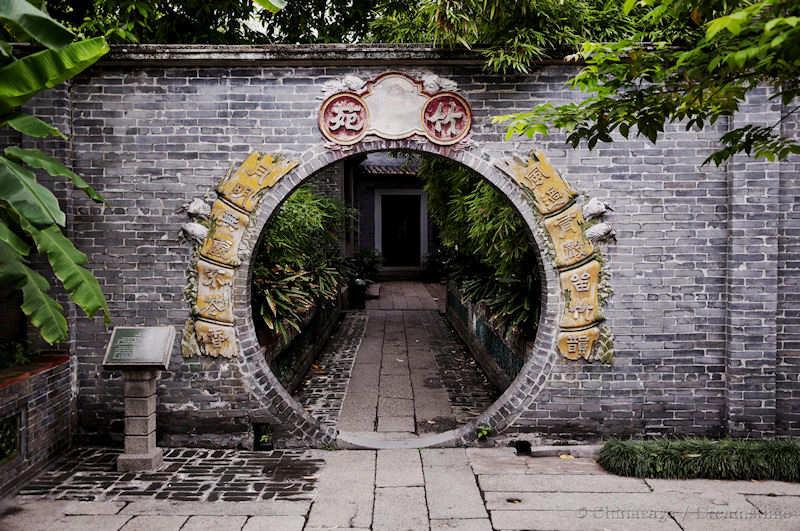
Moon gate in Qinghui garden, Foshan city, Guangdong
Conventions
We use a consistent style for links within Chinasage. An internal link taking you to another page within our site is shown like this while a link to a page on any other web site is shown like this ➚ .
We use Chinese characters wherever appropriate. Most browsers should display both the characters and the pinyin correctly. We highlight any use of the older Wade Giles system for 'spelling' characters. Except where stated all characters are the modern simplified form used in the People's Republic rather than the traditional ones (pre-1970s). To help you learn Chinese characters many of the very common characters are highlighted thus: 中
Dates are given using the BCE/CE ➚ (Before Common Era and in Common Era) year convention rather than BC/AD. If a date is not followed by BCE or CE it should be taken as CE.
Authorship
All the text on the Chinasage web site is my own, I do not copy and paste from other web sites. I research each topic from a number of authoritative sources (mainly books ). The only exception to this are quotations and image credits. All text is our copyright and can not be used/copied without my permission. I am independent of any other company or government, the opinions expressed are my own. I do not receive funding or backing from any agency or organization .
Teacup Media (China History Podcast)
I am delighted to be able to promote links to Laszlo Montgomery's excellent Teacup Media ➚ series created over the last 15 years. Laszlo Montgomery ➚ has in depth knowledge of building commercial contacts with China over 30 years. The set of 290 podcasts totals 150 hours of audio commentary which covers every conceivable topic in Chinese history. Highly recommended.
Acknowledgments
I am extremely grateful to the many people who have put their photographs online for anyone to adapt and use. Without them this site would be very drab. If I am not using the image license correctly please let me know. I am grateful to Kim Dramer ➚ for permission to use her short videos all about Chinese culture and traditions. Patreon subscribers have supported the web site and allowed us to amongst other things purchase some quality images of China for use here. Some pages use Javascript ➚ to create special effects such as our airport table and calendar . I am grateful to the original authors for providing their code to be used and adapted by anyone else. The online Chinese dictionary uses the definitions from the CC-CEDICT project ➚ for which I am grateful for a generous free license. Sound files kindly provided by shtooka.net ➚ under a Creative Commons Attribution Share Alike License.
Feel free to contact Chinasage to point out any errors, omissions or suggestions on how to improve this web site.
If you would like to support my work and keep us independent become a Patreon or make a Donation via Paypal.