Chinasage : All about China
China sage's information will be of use to anyone keen to learn more about the world's upcoming nation. We cover all aspects of China in hundreds of detailed pages which include all sorts of cultural traditions , descriptions of every Chinese province and history , including all the dynasties. We hope you make ChinaSage the home for your study of China.
You can also check out your knowledge of China with our Quiz section .
Traditions
About Chinasage
We’re building an extensive set of information all about China. We found other sites too detailed (such as Wikipedia) or just too old-fashioned. What we thought was needed was a carefully constructed site with strict editorial control so that everything is consistent and easy to navigate without clutter.
The name “Chinasage” came about because it can be read as either “China sage” (中 国 英 明 zhōng guó yīng míng ) or “China’s age” (中 国 时 代 zhōng guó shí dài ) , which promotes our new knowledge resource at a time when China has come of age in the world.
Southern refuge
When northern China was overrun by Khitans and then Mongols 800 years ago the Imperial Song family moved to Hangzhou . It proved to be a peaceful and prosperous time for 150 years. In memory of this period some scenes of Hangzhou are still to be found in the long corridors of the Summer Palace , Beijing.
Getting by in China There are many customs and traditions that you should know before traveling to China. Our customs page covers such things as giving gifts, banquets, sealing business deals and how to behave in public. A respect for age old traditions will impress your hosts who will appreciate your efforts to embrace the culture. Read more…
Buddhism in China Buddhism came into China from northern India over a thousand years ago and within a short space of time became the dominant religion. There remain many Buddhist temples dotted all over China that have managed to survive into modern times. The Buddha lived his life in Nepal, on China's doorstep and preached about of the relief of suffering by resisting desires of all kinds. Read more…
Dragons, master of rain and water The Chinese dragon is no fire-breathing monster, in China they are regarded as powerful but benevolent. As dragons are masters of rain, water and sea they need to be brought on your side if you want a good harvest, and so they need suitable offerings. The Dragon Boat festival is when everyone seeks to appease the dragon kings. Read more…
Chinese Silk Along with porcelain and tea, silk is one of China's important innovations. The secret of this great invention was closely guarded for centuries. Fabulous fine cloth was an important export as far back as the early Roman Empire and it was in Rome where a law was passed to ban the wearing of silk. Read more…
Lucky Bats Bats are commonly used in handicrafts, paintings and artwork to give a wish for good luck. This is because 'bat' and 'good luck' sound the same in Chinese. Read more…
Ancient stone writings Stone steles form the most permanent of records. Over the centuries they have been used as memorials, reference libraries, calligraphy samples and poems. Visitors to China will have seen these revered inscriptions in all sorts of locations: mountains, houses, parks and museums documenting the lives and feelings of people over the centuries. They are a powerful and permanent expression of the continuity of Chinese history. Read more…
The game of Mahjong People playing the popular game of Mahjong can often be seen in public parks, cafes and at home. It is a game of both skill and chance and a good head for calculation of probabilities is needed. Since 1920 Mahjong has also been widely played outside China. Read more…
Peony The peony is a frequent art motif in China. It is considered one of the best flowers of spring and was much loved by Empress Wu Zetian . Read more…
Cracking China book
Your A-Z key to understanding China
We are proud to announce a printed book all about China based loosely on this web site. It is a set of sixty topics in A-Z order covering everything from hair to kiwifruit, clapping to rhubarb, eunuchs to dragons. Buying a copy will help support Chinasage . Now available as a Kindle eBook for just $3.90.
Details... ➚
Traditional medicine in China Thousands of years of seeking cures to illness in China has led to a wide range of traditional medicines and procedures being discovered. Nowadays traditional medicine is used for minor ailments and when western medicine offers no cure. Read more…
History
Dip into history Our history section has a page for each major dynasty, for the whole period from the time of myths and legends 5,000 years ago all the way through the Han, Tang, Song, Ming dynasties to the last great dynasty the Qing. Read more…
The Chinese Emperor The institution of Emperor , as head of the Chinese family of people, lasted for thousands of years and to some extent lives on with the Presidency. In China there has been great respect for the Emperor/President who in turn is expected to rule wisely with the best interests of his subjects in mind. To early European visitors to China the structure was considered close to the ideal form of society. Read more…
Song dynasty The Song dynasty is a period of Chinese refinement and peace rather than military prowess. Great strides were taken in the creative arts and literature. Prosperity from the growing trade by sea rather than overland fueled the building of huge cities. The eventual conquest by the Mongol hordes brought the dynasty to a tragic close. Read more…
Quintessence of the Nation Traditional Chinese Opera was the entertainment of all Chinese over many centuries. A long evening performance contains elements of drama, music, comedy, acrobatics and martial arts. Each region has its own distinctive form. Over time complex body movements represent specific meanings as a very sparse set is used. The art form has inspired many Western composers and playwrights to emulate the style. Read more…
Book of Changes - Deciphered
The Yi Jing is the premier ancient classic in China, and yet at the heart of this very strange but important book is a mystery that has remained unsolved for 3,000 years. The ‘Book of Changes - Deciphered’ describes the history and importance of the Yi Jing (I Ching) and proposes a new solution to the ancient mystery. Buying a copy will help support Chinasage . Now also available in Kindle eBook format for just $5.99.
Details... ➚
Relations with Taiwan - the One China Policy An exploration into the current debate about the status of Taiwan with a look into the complex history and some thoughts on the future. Read more…
The Peoples of China China although predominately populated with the Han Chinese , has over 100 million people identified as belonging to other ethnic minorities. However these people are concentrated in the less densely populated 'fringes' of China so may form the majority in some regions. Read more…
Geography
China's diverse geography China has deserts, mountains, lakes, rain forests and almost every other type of geographical feature you can think of. Our geography section has pages for each individual province as well as the great Yangzi and Yellow rivers. There are also pages on climate, cities, population, ethnic people, airports and universities. Read more…
Places to visit There is a great deal to see in China; it is impossible to see everything in one visit. Our visitor attraction page gives a wide range of places to visit all over China, and not just the obvious ones. Read more…
Yangzi River The mighty Yangzi River is the longest in China and third longest in the world. It has carried huge quantities of people and goods over the centuries. Many great cities lie close to its banks: Chongqing, Wuhan, Nanjing and Shanghai. Read more…
Hainan Island The island of Hainan is China's southernmost province. Many Chinese travel here for a holiday in the sun and recently some have been buying up holiday flats and houses. The tropical climate allows bananas and palms to flourish. Read more…
China's Neighbors The countries that surround China have an interesting history. Wars, conquest and religion have defined the current boundaries of the Peoples' Republic. India, Russia, Pakistan, Myanmar and Afghanistan all have important borders with China. Read more…
Jade
The Chinese prize the mineral jade above gold. It is associated with many ancient traditions and customs. Originally the precious mineral was mined in the Kunlun mountains of southern Xinjiang . In ancient times kings and emperors were buried with their bodies encased in hundreds of tiny jade fragments linked with gold wire - this was intended to keep the body imperishable. Read more…
All about the religions of China Untangling the religions of China is quite a challenge. There are three main belief systems (principally: Confucianism, Daoism and Buddhism) that have co-existed in harmony for a very long time. Islam, Christianity and Ancestor veneration are also described in our comprehensive guide. Read more…
Language
The Chinese Language The Chinese language is rightly treasured as the country's greatest accomplishment. Our language section describes the language and its history. The section includes some introductory lessons and a guide to writing the characters. Read more…
Good fortune You will often see the character for good fortune 褔 fú on decorations and gifts. 'Fu' is also associated with bats and oranges and this has a surprising explanation... Read more…
Chinese characters Some Chinese characters have their origin 10,000 years ago. The very old forms are simplified pictures of objects and animals. Later more abstract notions were represented in a simple way. Now there are a total of 200,000 distinct characters but fortunately only 2,000 are needed for everyday life. Read more…
A survey of Chinese literature As both the book and printing were invented in China it is not surprising that Chinese literature has a long and distinguished history. There are a number of very famous novels from before the time of Shakespeare including The Romance of the Three Kingdoms and The Water Margin. Read more…
Book of Changes - Deciphered
The Yi Jing is the premier ancient classic in China, and yet at the heart of this very strange but important book is a mystery that has remained unsolved for 3,000 years. The ‘Book of Changes - Deciphered’ describes the history and importance of the Yi Jing (I Ching) and proposes a new solution to the ancient mystery. Buying a copy will help support Chinasage . Now also available in Kindle eBook format for just $5.99.
Details... ➚
Bits and Pieces
We need your help to keep the Chinasage web site growing. We'd love to keep this web site completely free of advertisements like Wikipedia. Please consider becoming a Patreon subscriber for however little or much you can afford. We have been running this campaign for two months and have so far raised only 10% of our target. So please help… or else advertisements will make a comeback!
To read more and take out a subscription simply click on the Patreon Patreon
Many thanks, much appreciated.
Tue 20th Sep 2022Patreon pictures Thanks to the generous donations from Chinasage's Patreon ➚ sponsors we've just added quality photographs to many of our pages.
Although you can get images of all sorts of thing for free you do still have to pay for quality, particularly for specialist subjects. This time we have used 123rf for the new images who claim to have 200 million images to choose from. It takes a long time to make a choice and then they all need editing for usage, tagging and finally putting on the appropriate place on our hundreds of pages. We hope you will agree that they make a significant improvement.
New Year dragon, Shanghai Read more…
Southern refuge
When northern China was overrun by Khitans and then Mongols 800 years ago the Imperial Song family moved to Hangzhou . It proved to be a peaceful and prosperous time for 150 years. In memory of this period some scenes of Hangzhou are still to be found in the long corridors of the Summer Palace , Beijing.
Chinese coolies 1845-1880 When African slavery was made illegal in the UK and US, employers turned to China for supply of labor. The conditions were just as appalling as for the Africans. A technicality allowed employers to claim this was not slavery but Chinese were bought at markets and had little chance of returning home. This little known trade began in 1845 and lasted about 35 years before the Chinese and some foreign governments put a stop to it. Read more…
The Long March The epic tale of the struggle of thousands of soldiers over thousands of miles of challenging terrain has been held up as the chief heroic episode in the early days of the Communist party. It was during the Long March that Mao Zedong emerged as leader with his own vision for the future of China. Read more…
Chinese Calligraphy The Chinese language is a treasure trove of history and traditions. The language script has been in use for over 4,000 years. Fine historic pieces by the great masters continue to achieve as high a price at auction as great paintings. To appreciate Chinese writing it is important to know how the characters are made with the brush. Read more…
Imperial Examinations One of China's most important exports was the respect for scholarship and learning. China was the first nation to appoint on basis of what they knew rather than who they knew. Strict examinations were set up two thousand years ago and were the passport to a quieter life with a steady income. Read more…
Macau
Macau has overtaken Las Vegas as the top city for gambling in the world. It has the largest casino anywhere. Rich Chinese visitors come to the semi-autonomous district for short breaks to spend time and money in the casinos and at the horse races. Read more…
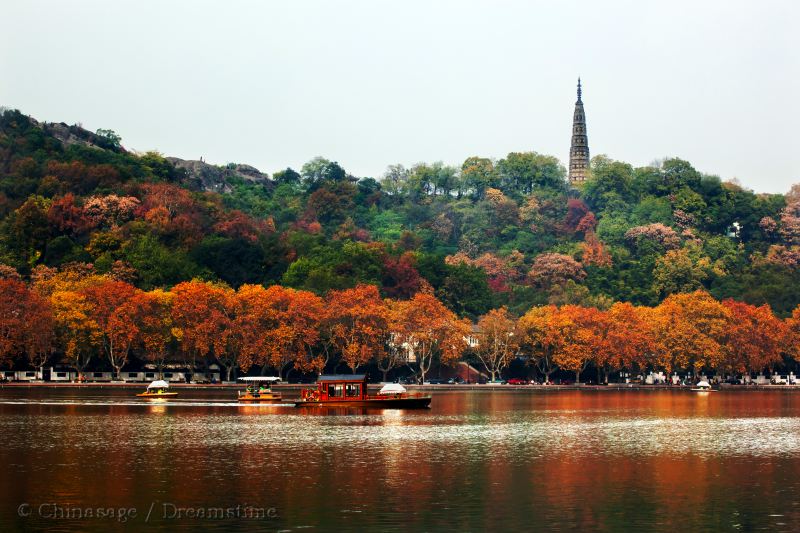
Autumn view of West Lake and Pagoda at Hangzhou , Zhejiang
Conventions
We use a consistent style for links within Chinasage. An internal link taking you to another page within our site is shown like this while a link to a page on any other web site is shown like this ➚ .
We use Chinese characters wherever appropriate. Most browsers should display both the characters and the pinyin correctly. We highlight any use of the older Wade Giles system for 'spelling' characters. Except where stated all characters are the modern simplified form used in the People's Republic rather than the traditional ones (pre-1970s). To help you learn Chinese characters many of the very common characters are highlighted thus: 中
Dates are given using the BCE/CE ➚ (Before Common Era and in Common Era) year convention rather than BC/AD. If a date is not followed by BCE or CE it should be taken as CE.
Authorship
All the text on the Chinasage web site is my own, I do not copy and paste from other web sites. I research each topic from a number of authoritative sources (mainly books ). The only exception to this are quotations and image credits. All text is our copyright and can not be used/copied without my permission. I am independent of any other company or government, the opinions expressed are my own. I do not receive funding or backing from any agency or organization .
Teacup Media (China History Podcast)
I am delighted to be able to promote links to Laszlo Montgomery's excellent Teacup Media ➚ series created over the last 15 years. Laszlo Montgomery ➚ has in depth knowledge of building commercial contacts with China over 30 years. The set of 290 podcasts totals 150 hours of audio commentary which covers every conceivable topic in Chinese history. Highly recommended.
Acknowledgments
I am extremely grateful to the many people who have put their photographs online for anyone to adapt and use. Without them this site would be very drab. If I am not using the image license correctly please let me know. I am grateful to Kim Dramer ➚ for permission to use her short videos all about Chinese culture and traditions. Patreon subscribers have supported the web site and allowed us to amongst other things purchase some quality images of China for use here. Some pages use Javascript ➚ to create special effects such as our airport table and calendar . I am grateful to the original authors for providing their code to be used and adapted by anyone else. The online Chinese dictionary uses the definitions from the CC-CEDICT project ➚ for which I am grateful for a generous free license. Sound files kindly provided by shtooka.net ➚ under a Creative Commons Attribution Share Alike License.
Feel free to contact Chinasage to point out any errors, omissions or suggestions on how to improve this web site.
If you would like to support my work and keep us independent become a Patreon or make a Donation via Paypal.