Chinasage : All about China
China sage's information will be of use to anyone keen to learn more about the world's upcoming nation. We cover all aspects of China in hundreds of detailed pages which include all sorts of cultural traditions , descriptions of every Chinese province and history , including all the dynasties. We hope you make ChinaSage the home for your study of China.
You can also check out your knowledge of China with our Quiz section .
Traditions
About Chinasage
We’re building an extensive set of information all about China. We found other sites too detailed (such as Wikipedia) or just too old-fashioned. What we thought was needed was a carefully constructed site with strict editorial control so that everything is consistent and easy to navigate without clutter.
The name “Chinasage” came about because it can be read as either “China sage” (中 国 英 明 zhōng guó yīng míng ) or “China’s age” (中 国 时 代 zhōng guó shí dài ) , which promotes our new knowledge resource at a time when China has come of age in the world.
Southern refuge
When northern China was overrun by Khitans and then Mongols 800 years ago the Imperial Song family moved to Hangzhou . It proved to be a peaceful and prosperous time for 150 years. In memory of this period some scenes of Hangzhou are still to be found in the long corridors of the Summer Palace , Beijing.
Getting by in China There are many customs and traditions that you should know before traveling to China. Our customs page covers such things as giving gifts, banquets, sealing business deals and how to behave in public. A respect for age old traditions will impress your hosts who will appreciate your efforts to embrace the culture. Read more…
Plum The plum is one of the earliest trees to flower and this often coincides with Chinese New Year. It is considered one of the three friends of winter for this reason. As a symbol it represents long life as the tree is long lived and takes many years to come to flower. Read more…
The standing of women in China Attitudes to women have changed greatly in China over the centuries. The traditional subservient position of women in society was removed in only the last sixty years but there yet to be a woman appointed to the top rung of government. Our section describes the role of women down the centuries including the role of concubines and how some Imperial women bucked the trend. Read more…
Du Fu
The famous Tang dynasty poet Du Fu 's (杜甫 712 - 770) small thatched cottage can still be seen at Chengdu the capital city of Sichuan province. Read more…
Year of the ... Most people are familiar with the twelve years and their animals. Chinese astrology is about the year of birth rather than the month of birth and so all people born in a particular year share some characteristics. Even to this day couples arrange birth of children to fall in 'lucky' years. Read more…
Chinese architecture China's distinctive traditional architecture is one of her core cultural treasures. From pagodas, temples to hutong courtyards the Chinese building tradition has changed little until modern times. Fine examples of exquisite workmanship can be found all over China. Today impressive buildings are being constructed using the best available technology. Read more…
A survey of Chinese literature As both the book and printing were invented in China it is not surprising that Chinese literature has a long and distinguished history. There are a number of very famous novels from before the time of Shakespeare including The Romance of the Three Kingdoms and The Water Margin. Read more…
Toad Frogs and toads are valued in China because they keep down insect pests on crops. In some regions their name is similar to qián 'money, coin' and this has given them an association with good fortune and luck. Read more…
Cracking China book
Your A-Z key to understanding China
We are proud to announce a printed book all about China based loosely on this web site. It is a set of sixty topics in A-Z order covering everything from hair to kiwifruit, clapping to rhubarb, eunuchs to dragons. Buying a copy will help support Chinasage . Now available as a Kindle eBook for just $3.90.
Details... ➚
Southern refuge
When northern China was overrun by Khitans and then Mongols 800 years ago the Imperial Song family moved to Hangzhou . It proved to be a peaceful and prosperous time for 150 years. In memory of this period some scenes of Hangzhou are still to be found in the long corridors of the Summer Palace , Beijing.
History
Dip into history Our history section has a page for each major dynasty, for the whole period from the time of myths and legends 5,000 years ago all the way through the Han, Tang, Song, Ming dynasties to the last great dynasty the Qing. Read more…
First British contacts with China A survey of all the first British contacts to China up until 1700. These include 'pirates' like John Weddell who sought to force China into trading with England down the barrel of a cannon and John Webb a committed fan of everything about China. Regrettably this honeymoon period of relations was not to last. Read more…
China's Ancient Script The discovery of a huge number of 'oracle bones' has greatly added to the knowledge of the origins of China's written script. It pushes back the written language to at least 3,500 years ago. Careful study of the inscriptions is still revealing information about life in Shang dynasty times. Read more…
Warring States The second part of the Zhou dynasty was known for incessant warfare between kingdoms. It was a time of great importance to China as the philosophical traditions were developed that went on to dominate Chinese thinking in the next two thousand years as it was the time of Confucius and Laozi. Read more…
Righteous Fists 1898-1901 The Boxer rebellion came in the final, faltering stage of the Qing dynasty. Dowager Empress Cixi used the widespread hatred of foreigners taking unfair advantage of China's weakness to support the grassroots revolt. It did not end well. Read more…
The building of China's railways The building of railways became a competitive scramble in the late 19th and early 20th century. Railways were seen as the key step to opening up inland China for trade. Britain, France, Germany, Japan and America all invested heavily in railway construction only for the the money to be lost in the following years of turmoil. Read more…
Southern refuge
When northern China was overrun by Khitans and then Mongols 800 years ago the Imperial Song family moved to Hangzhou . It proved to be a peaceful and prosperous time for 150 years. In memory of this period some scenes of Hangzhou are still to be found in the long corridors of the Summer Palace , Beijing.
Geography
China's diverse geography China has deserts, mountains, lakes, rain forests and almost every other type of geographical feature you can think of. Our geography section has pages for each individual province as well as the great Yangzi and Yellow rivers. There are also pages on climate, cities, population, ethnic people, airports and universities. Read more…
All about bamboo The most versatile of plants is the bamboo, it is used as food and for baskets, tubes, scaffolding, musical instruments and much more. In south-west China it forms vast forests. Read more…
Hainan Island The island of Hainan is China's southernmost province. Many Chinese travel here for a holiday in the sun and recently some have been buying up holiday flats and houses. The tropical climate allows bananas and palms to flourish. Read more…
China's ancient heartland The modern province of Shaanxi has many sites of historic interest. Perhaps none more so than the tomb of the First Qin Emperor with its thousands of Terracotta warriors. With the great Yellow River, mountains and arid areas there is a great deal of scenic beauty too. Read more…
Ancient province of Shandong The eastern province of Shandong sticks out into the Yellow Sea and has many historic attractions. It boasts the birthplace of Confucius and also the manufacture of Qingdao beer. The most sacred mountain in China - Taishan - has many ancient temples and memorials. Read more…
找 zhǎo to try to find; to look for; to call on somebody 戈 gē spear radical 62, 扌 shǒu hand radical 64]Full information for 找
Modern Leaders The leadership of the People's Republic since 1949 has been one of stability with an emphasis on steady progress. With China such a major power it is important to understand the background to the handful of people who have led China in a new direction. Read more…
Language
The Chinese Language The Chinese language is rightly treasured as the country's greatest accomplishment. Our language section describes the language and its history. The section includes some introductory lessons and a guide to writing the characters. Read more…
Chinese characters Some Chinese characters have their origin 10,000 years ago. The very old forms are simplified pictures of objects and animals. Later more abstract notions were represented in a simple way. Now there are a total of 200,000 distinct characters but fortunately only 2,000 are needed for everyday life. Read more…
Understanding the Date and Time in Chinese Telling the date and time is essential for travelers. In China the Arabic numbers are used for writing but the Chinese characters are used for reading. Read more…
Traditional and Simplified When you start learning Chinese you soon across the fact that there are two written forms still in use, the simplified form used in China and the old, traditional form still used in Taiwan, Hong Kong and other overseas Chinese communities. With 4,000 years of use the written Chinese language has many archaic features. On the formation of the Peoples' Republic an ambitious reform of the script was instigated which has made the learning of the characters far easier. Read more…
China's Neighbors The countries that surround China have an interesting history. Wars, conquest and religion have defined the current boundaries of the Peoples' Republic. India, Russia, Pakistan, Myanmar and Afghanistan all have important borders with China. Read more…
Bits and Pieces
We need your help to keep the Chinasage web site growing. We'd love to keep this web site completely free of advertisements like Wikipedia. Please consider becoming a Patreon subscriber for however little or much you can afford. We have been running this campaign for two months and have so far raised only 10% of our target. So please help… or else advertisements will make a comeback!
To read more and take out a subscription simply click on the Patreon Patreon
Many thanks, much appreciated.
Tue 20th Sep 2022Patreon pictures Thanks to the generous donations from Chinasage's Patreon ➚ sponsors we've just added quality photographs to many of our pages.
Although you can get images of all sorts of thing for free you do still have to pay for quality, particularly for specialist subjects. This time we have used 123rf for the new images who claim to have 200 million images to choose from. It takes a long time to make a choice and then they all need editing for usage, tagging and finally putting on the appropriate place on our hundreds of pages. We hope you will agree that they make a significant improvement.
New Year dragon, Shanghai Read more…
Southern refuge
When northern China was overrun by Khitans and then Mongols 800 years ago the Imperial Song family moved to Hangzhou . It proved to be a peaceful and prosperous time for 150 years. In memory of this period some scenes of Hangzhou are still to be found in the long corridors of the Summer Palace , Beijing.
Cantonese Language The Cantonese language or 'Yue' language is still spoken by over 50 million people in Southern China (Guangdong, Guangxi, Hong Kong and Macau ). Although the written form is very similar to Mandarin the spoken language is very different. Read more…
Air travel in China Here we list all China's main airports , giving information on location, facilities and easy to use distance calculator so you can plan a complex itinerary around China. We also give useful visitor information about air transport in China. Read more…
The Long March The epic tale of the struggle of thousands of soldiers over thousands of miles of challenging terrain has been held up as the chief heroic episode in the early days of the Communist party. It was during the Long March that Mao Zedong emerged as leader with his own vision for the future of China. Read more…
Great Inventions The four great Chinese inventions are considered to be: paper; printing ; compass and gunpowder . Other key inventions include the abacus, iron casting, pasta, silk etc.. However the production of paper and then printing must be considered the most important of these. Read more…
The illustrious Ming dynasty The most famous Chinese dynasty is the Ming dynasty . China emerged from the Mongol conquest to become pre-eminent nation, with the greatest wealth, population and foreign trade of any nation. It was during the Ming dynasty that China achieved many accomplishments: a vast fleet sailed the seas and made many discoveries and an encyclopedia of all knowledge was distilled into 11,000 chapters. Read more…
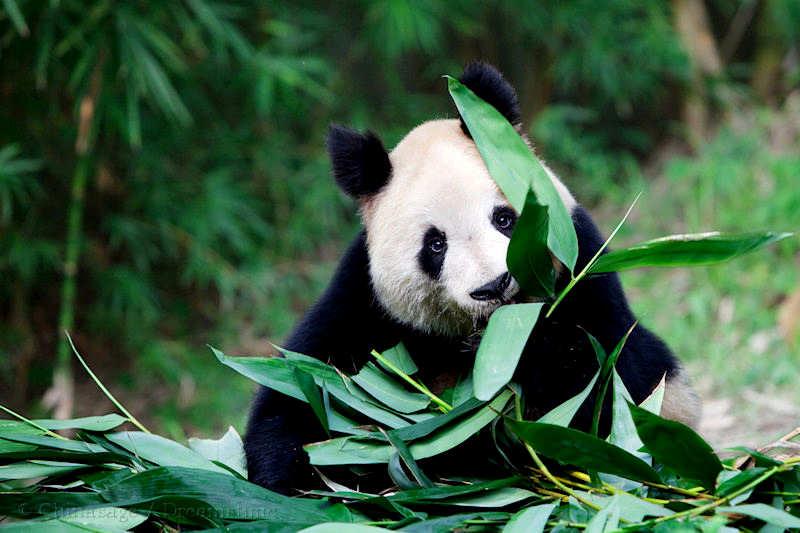
An adult Giant Panda eating bamboo
Conventions
We use a consistent style for links within Chinasage. An internal link taking you to another page within our site is shown like this while a link to a page on any other web site is shown like this ➚ .
We use Chinese characters wherever appropriate. Most browsers should display both the characters and the pinyin correctly. We highlight any use of the older Wade Giles system for 'spelling' characters. Except where stated all characters are the modern simplified form used in the People's Republic rather than the traditional ones (pre-1970s). To help you learn Chinese characters many of the very common characters are highlighted thus: 中
Dates are given using the BCE/CE ➚ (Before Common Era and in Common Era) year convention rather than BC/AD. If a date is not followed by BCE or CE it should be taken as CE.
Authorship
All the text on the Chinasage web site is my own, I do not copy and paste from other web sites. I research each topic from a number of authoritative sources (mainly books ). The only exception to this are quotations and image credits. All text is our copyright and can not be used/copied without my permission. I am independent of any other company or government, the opinions expressed are my own. I do not receive funding or backing from any agency or organization .
Teacup Media (China History Podcast)
I am delighted to be able to promote links to Laszlo Montgomery's excellent Teacup Media ➚ series created over the last 15 years. Laszlo Montgomery ➚ has in depth knowledge of building commercial contacts with China over 30 years. The set of 290 podcasts totals 150 hours of audio commentary which covers every conceivable topic in Chinese history. Highly recommended.
Acknowledgments
I am extremely grateful to the many people who have put their photographs online for anyone to adapt and use. Without them this site would be very drab. If I am not using the image license correctly please let me know. I am grateful to Kim Dramer ➚ for permission to use her short videos all about Chinese culture and traditions. Patreon subscribers have supported the web site and allowed us to amongst other things purchase some quality images of China for use here. Some pages use Javascript ➚ to create special effects such as our airport table and calendar . I am grateful to the original authors for providing their code to be used and adapted by anyone else. The online Chinese dictionary uses the definitions from the CC-CEDICT project ➚ for which I am grateful for a generous free license. Sound files kindly provided by shtooka.net ➚ under a Creative Commons Attribution Share Alike License.
Feel free to contact Chinasage to point out any errors, omissions or suggestions on how to improve this web site.
If you would like to support my work and keep us independent become a Patreon or make a Donation via Paypal.