Chinasage : All about China
China sage's information will be of use to anyone keen to learn more about the world's upcoming nation. We cover all aspects of China in hundreds of detailed pages which include all sorts of cultural traditions , descriptions of every Chinese province and history , including all the dynasties. We hope you make ChinaSage the home for your study of China.
You can also check out your knowledge of China with our Quiz section .
Traditions
About Chinasage
We’re building an extensive set of information all about China. We found other sites too detailed (such as Wikipedia) or just too old-fashioned. What we thought was needed was a carefully constructed site with strict editorial control so that everything is consistent and easy to navigate without clutter.
The name “Chinasage” came about because it can be read as either “China sage” (中 国 英 明 zhōng guó yīng míng ) or “China’s age” (中 国 时 代 zhōng guó shí dài ) , which promotes our new knowledge resource at a time when China has come of age in the world.
Southern refuge
When northern China was overrun by Khitans and then Mongols 800 years ago the Imperial Song family moved to Hangzhou . It proved to be a peaceful and prosperous time for 150 years. In memory of this period some scenes of Hangzhou are still to be found in the long corridors of the Summer Palace , Beijing.
Getting by in China There are many customs and traditions that you should know before traveling to China. Our customs page covers such things as giving gifts, banquets, sealing business deals and how to behave in public. A respect for age old traditions will impress your hosts who will appreciate your efforts to embrace the culture. Read more…
All Chinese Festivals Our extensive section on Chinese festivals gives the dates and backgrounds on over 30 of them. Our festivals page has full details of the origin and observance of each of them as well as a handy diary for when they will next fall. Essential when planning a trip to China. Read more…
How to write Chinese characters Many Chinese spend a great deal of time studying calligraphy. To be able to write (or more accurately paint) Chinese characters requires lots of practice as well as knowing both the brush strokes and the order in which to make them. Read more…
Dao De Jing ancient classic The Dao De Jing (or Tao Te Ching using the old spelling) is a much loved Chinese classic. It is written as a series of short, individual thoughts and contemplations of our place in the world. It follows the Daoist (Taoist) philosophical tradition. It is over 2,500 years old but still has a message for us today. Read more…
Hares and Rabbits Hares and rabbits are treated as the same animal in China. Hares are associated with the moon as the Chinese saw a 'hare' rather than a 'man' in the moon. The Chinese moon rovers are called the 'Jade Rabbits'. Read more…
Symbols and Motifs Chinese arts and handicrafts are full of hidden symbols. Bats, goldfish, peonies and bees all give a specific meaning to a painting or decoration. Exploring the world of Chinese symbolism opens up a whole new layer of appreciation. Read more…
Feng Shui The ancient tradition of Feng Shui has been far reaching for thousands of years. It is still practiced today, particularly for choosing the site for buildings and graves. With the goal of harmony and balance with nature, it has excellent environmental credentials. Read more…
Chinese numbers Learning the numbers in Chinese is easier than in many other languages. In our complete guide to the numbers we include the traditions associated them. For example, do you know why 4 is unlucky but 8 lucky? Read more…
Cracking China book
Your A-Z key to understanding China
We are proud to announce a printed book all about China based loosely on this web site. It is a set of sixty topics in A-Z order covering everything from hair to kiwifruit, clapping to rhubarb, eunuchs to dragons. Buying a copy will help support Chinasage . Now available as a Kindle eBook for just $3.90.
Details... ➚
History
Dip into history Our history section has a page for each major dynasty, for the whole period from the time of myths and legends 5,000 years ago all the way through the Han, Tang, Song, Ming dynasties to the last great dynasty the Qing. Read more…
Han Dynasty After the trauma of the Qin dynasty it was the succeeding Han dynasty that established China as a stable nation. Many Imperial institutions inaugurated at this time lasted for the next two thousand years. Together with the Tang and Ming it is considered one of the great periods of Chinese history. Read more…
The early history of China from pre-history to 770BCE Most of the ancient traditions of China had become established 3,000 years ago. The institution of Emperor, the written scripts and the key technologies (including silk) all come from China's distant past. The longevity and continuity of Chinese culture are the two key principles to understanding China - even today. Read more…
Three Character Classic The Three Character Classic (San Zi Jing 三 字 经 language primer for children who aspired to a scholarly life. It introduces the student to Chinese history, philosophy as well as the most common characters. It contains many exhortations for the student to study long and hard. Read more…
Southern refuge
When northern China was overrun by Khitans and then Mongols 800 years ago the Imperial Song family moved to Hangzhou . It proved to be a peaceful and prosperous time for 150 years. In memory of this period some scenes of Hangzhou are still to be found in the long corridors of the Summer Palace , Beijing.
Superpower China An in-depth overview of the position of China in the world and its likely future. Is China on track to become the leading world super-power as it once was? For thousands of years China was by any measure the top nation on Earth, and so it seems natural that after 150 years of turmoil China will become the leading country again. We speculate on what this might mean to China and the rest of the world. Read more…
Modern Leaders The leadership of the People's Republic since 1949 has been one of stability with an emphasis on steady progress. With China such a major power it is important to understand the background to the handful of people who have led China in a new direction. Read more…
Song dynasty The Song dynasty is a period of Chinese refinement and peace rather than military prowess. Great strides were taken in the creative arts and literature. Prosperity from the growing trade by sea rather than overland fueled the building of huge cities. The eventual conquest by the Mongol hordes brought the dynasty to a tragic close. Read more…
Geography
China's diverse geography China has deserts, mountains, lakes, rain forests and almost every other type of geographical feature you can think of. Our geography section has pages for each individual province as well as the great Yangzi and Yellow rivers. There are also pages on climate, cities, population, ethnic people, airports and universities. Read more…
China's Silk Road The silk road from China leading to India and also through Central Asia to the Middle East was the longest trade route by land. It allowed early contact between the Roman Empire and China when silk was in great demand in Rome. The trade brought great prosperity to the cities of Central Asia such as Samarkand and Bactra. Read more…
The Peoples of China China although predominately populated with the Han Chinese , has over 100 million people identified as belonging to other ethnic minorities. However these people are concentrated in the less densely populated 'fringes' of China so may form the majority in some regions. Read more…
Chinese Universities We include a comprehensive guide to the top Universities in China giving details of student numbers, location, ranking and a bit about their history. Read more…
Giant Pandas of China The emblematic Giant Panda acts as China's ambassador in many leading zoos around the world. A captive breeding program has proved effective in bringing the cutest of animals back from the brink of extinction. Read more…
Silk
The silkworm (the caterpillar of the silkworm moth Bombyx mori) munches its way through many leaves so it can later build a cocoon. White mulberry is the preferred foodstuff for producing silk but other leaves will do. It takes 9 pounds [4 kgs] of leaves to produce just 0.4 ounces [10.0 grams] of silk. A single cocoon can give up to a mile of silk thread. Read more…
Merger of three cities
The large commercial city of Wuhan on the Yangzi River is a relatively recent creation. The three cities of Wuchang, Hanyang and Hankou were merged in 1926. It stands at the confluence with the Han river (hence Hanyang and Hankou). Hankou was a treaty port dominated by European traders in the 19th century and retains some old buildings from this time period. Read more…
Language
The Chinese Language The Chinese language is rightly treasured as the country's greatest accomplishment. Our language section describes the language and its history. The section includes some introductory lessons and a guide to writing the characters. Read more…
Understanding the Date and Time in Chinese Telling the date and time is essential for travelers. In China the Arabic numbers are used for writing but the Chinese characters are used for reading. Read more…
Chinese Character Details The history and structure of many common Chinese characters is a fascinating study. In this section we look in details at a few hundreds of them. Read more…
Cantonese Language The Cantonese language or 'Yue' language is still spoken by over 50 million people in Southern China (Guangdong, Guangxi, Hong Kong and Macau ). Although the written form is very similar to Mandarin the spoken language is very different. Read more…
How well do you know China?
Which leader spent some time working at a tractor factory at Xinjian, Jiangxi?
<Select>
Zhou Enlai Jiang Zemin Zhu De Deng Xiaoping
Deng Xiaoping worked with
Liu Shaoqi on a mixed economy model for China in the early 1960s. When Mao unleashed the Cultural Revolution in 1966 Deng was lucky to escape with his life. He worked in a tractor factory at Xinjian,
Jiangxi in 1969, keeping a very low profile. He quickly returned to power after Mao's death in 1976.
See our Quizzes page
战 zhàn to fight; fight; war 占 zhān to observe; to divine, 戈 gē spear radical 62]Origin The phonetic 'zhan' is on the left side for once, 'spear' gives idea of conflict Full information for 战
Bits and Pieces
We need your help to keep the Chinasage web site growing. We'd love to keep this web site completely free of advertisements like Wikipedia. Please consider becoming a Patreon subscriber for however little or much you can afford. We have been running this campaign for two months and have so far raised only 10% of our target. So please help… or else advertisements will make a comeback!
To read more and take out a subscription simply click on the Patreon Patreon
Many thanks, much appreciated.
Tue 20th Sep 2022Patreon pictures Thanks to the generous donations from Chinasage's Patreon ➚ sponsors we've just added quality photographs to many of our pages.
Although you can get images of all sorts of thing for free you do still have to pay for quality, particularly for specialist subjects. This time we have used 123rf for the new images who claim to have 200 million images to choose from. It takes a long time to make a choice and then they all need editing for usage, tagging and finally putting on the appropriate place on our hundreds of pages. We hope you will agree that they make a significant improvement.
New Year dragon, Shanghai Read more…
Southern refuge
When northern China was overrun by Khitans and then Mongols 800 years ago the Imperial Song family moved to Hangzhou . It proved to be a peaceful and prosperous time for 150 years. In memory of this period some scenes of Hangzhou are still to be found in the long corridors of the Summer Palace , Beijing.
Mountainous Tibet The mountainous province of Tibet forms the highest possible land border between India and China. On the border with Nepal is the world's highest mountain: Mount Everest (or Qomolangma). Tibet's unique culture is a key attraction to visitors. Read more…
China's name Why do we call the country of China 'China'? It is not the name used by the Chinese people themselves. In fact there are a number of names used in the 'Middle Kingdom' that reflect the country's rich cultural and historic heritage. Read more…
The Lay-Osborn Flotilla of 1862-63 After China's defeat in the Opium Wars it is amazing that China then chose to buy a naval force from its former enemy Britain. Although boats were duly made, China refused to take delivery of them and Anglo-Chinese relations went into further decline. Read more…
China's rich range of wildlife China has a wide range of wild animals reflecting the great diversity of climate and geography - everything from tropical rain forest to arid sand desert. Many plants and animals can only be found in China. Read more…
Cracking China book
Your A-Z key to understanding China
We are proud to announce a printed book all about China based loosely on this web site. It is a set of sixty topics in A-Z order covering everything from hair to kiwifruit, clapping to rhubarb, eunuchs to dragons. Buying a copy will help support Chinasage . Now available as a Kindle eBook for just $3.90.
Details... ➚
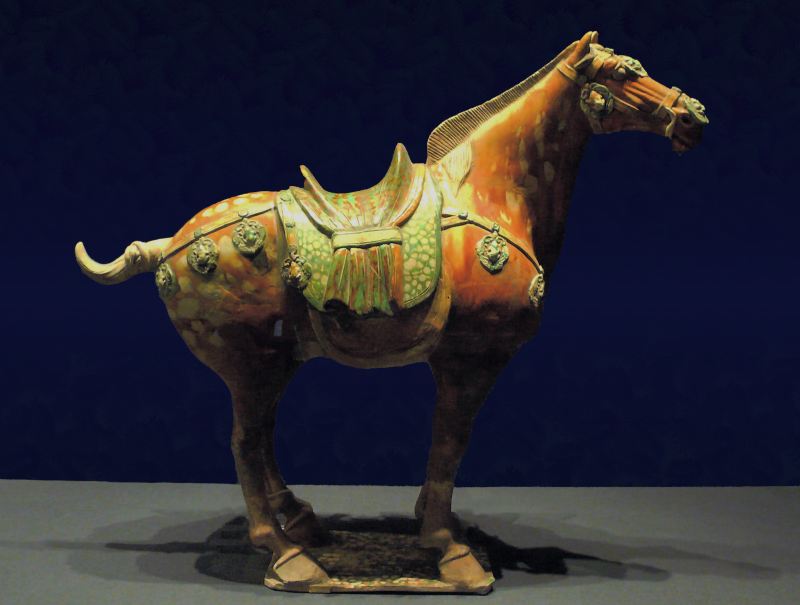
Photo by Rosemania ➚ , Palace Museum, Beijing. Sancai horse, Tang Dynasty, 618-907 A.D. Available under a Creative Commons license ➚ .
Conventions
We use a consistent style for links within Chinasage. An internal link taking you to another page within our site is shown like this while a link to a page on any other web site is shown like this ➚ .
We use Chinese characters wherever appropriate. Most browsers should display both the characters and the pinyin correctly. We highlight any use of the older Wade Giles system for 'spelling' characters. Except where stated all characters are the modern simplified form used in the People's Republic rather than the traditional ones (pre-1970s). To help you learn Chinese characters many of the very common characters are highlighted thus: 中
Dates are given using the BCE/CE ➚ (Before Common Era and in Common Era) year convention rather than BC/AD. If a date is not followed by BCE or CE it should be taken as CE.
Authorship
All the text on the Chinasage web site is my own, I do not copy and paste from other web sites. I research each topic from a number of authoritative sources (mainly books ). The only exception to this are quotations and image credits. All text is our copyright and can not be used/copied without my permission. I am independent of any other company or government, the opinions expressed are my own. I do not receive funding or backing from any agency or organization .
Teacup Media (China History Podcast)
I am delighted to be able to promote links to Laszlo Montgomery's excellent Teacup Media ➚ series created over the last 15 years. Laszlo Montgomery ➚ has in depth knowledge of building commercial contacts with China over 30 years. The set of 290 podcasts totals 150 hours of audio commentary which covers every conceivable topic in Chinese history. Highly recommended.
Acknowledgments
I am extremely grateful to the many people who have put their photographs online for anyone to adapt and use. Without them this site would be very drab. If I am not using the image license correctly please let me know. I am grateful to Kim Dramer ➚ for permission to use her short videos all about Chinese culture and traditions. Patreon subscribers have supported the web site and allowed us to amongst other things purchase some quality images of China for use here. Some pages use Javascript ➚ to create special effects such as our airport table and calendar . I am grateful to the original authors for providing their code to be used and adapted by anyone else. The online Chinese dictionary uses the definitions from the CC-CEDICT project ➚ for which I am grateful for a generous free license. Sound files kindly provided by shtooka.net ➚ under a Creative Commons Attribution Share Alike License.
Feel free to contact Chinasage to point out any errors, omissions or suggestions on how to improve this web site.
If you would like to support my work and keep us independent become a Patreon or make a Donation via Paypal.